
Twenty flanges in nineteen emails
A maintenance list usually mixes sizes, faces and locations. When each item arrives separately, the unit system, the tags and the drawing revision drift apart.
Compare split and wraparound flange covers for the working space you have. Bring one fitting or a tagged schedule of sizes and locations.
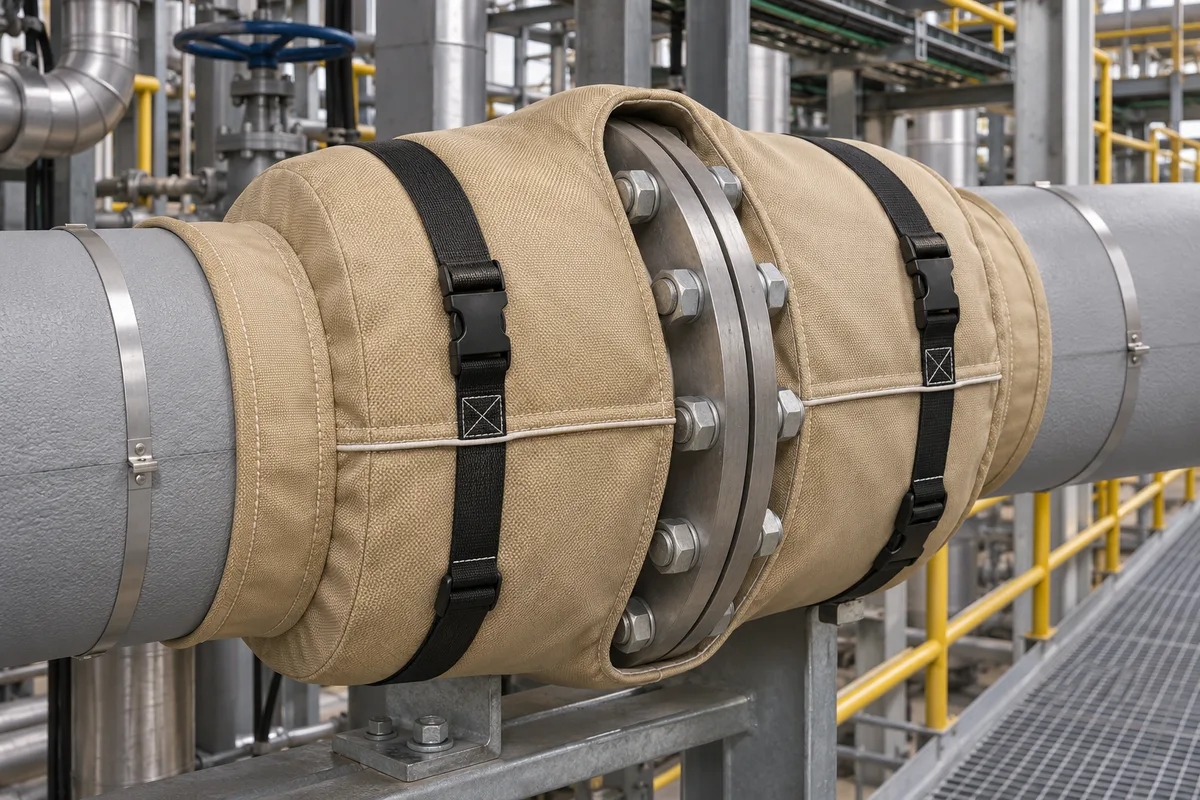
A maintenance list usually mixes sizes, faces and locations. When each item arrives separately, the unit system, the tags and the drawing revision drift apart.
Whether the gasket area and bolts must remain inspectable changes the structure. We record that requirement per item rather than assuming it applies to the whole schedule.
Available axial and radial space around a flange pair is often the limiting factor. A schedule that captures clearance is far more useful than a list of nominal sizes alone.
One row per flange or flange pair with a tag, nominal size and face type, quantity by size, available clearance, location and a note of any inspection point that must stay visible.
Start with the schedule. Attach drawings or scaled photos as they become available, and keep the revision identifier on each file.
Mark the space needed for bolt work and where the closure can be reached. Include adjacent insulation dimensions and the required direction of removal.
PDF, JPG or PNG, up to 5 files and 10 MB each. If you do not have a final drawing, a short description and one photo with a scale reference are enough to start.
Start a drawing-led RFQ →Add several TERCC-RD reference codes from the gallery, or paste an item schedule. Use one unit system and one revision identifier per drawing.
Open the gallery →